

In 1932, a New York court faced an unexpected question: Who was the “true ruler of Persia?” What began as a dispute over an inheritance soon turned into an international puzzle, exposing a deeper crisis of legitimacy at the heart of Iran’s monarchy.
The unusual case was reported that June in The Oregon Statesman newspaper. At the center of the dispute was the will of Ahmed Shah Qajar, the last ruler of Iran’s Turkish Qajar dynasty. Ahmed Shah had died in exile in France in 1930, leaving behind assets in the United States worth about 1.2 million dollars, a very large sum at the time. His will was brought before the New York Surrogate’s Court, drawing unexpected international attention.
What turned a routine inheritance case into something far more significant was the political question it raised. Reza Khan, who had taken the throne in 1925, was drawn into the proceedings. According to The Oregon Statesman, the court had suggested it might first have to decide “who the true heir to the throne was,” perhaps to determine which government’s laws should apply, in order to rule on the will itself.
The newspaper reported that Reza Khan presented himself in court as a descendant of the Turkish Qajar dynasty, the very dynasty he had overthrown with British support. His claim was immediately disputed by rival Qajar claimants. He made the assertion in response to the court’s central question of “who is the true ruler of Persia.” The episode was remarkable. Seven years after seizing power as a “humble ex-soldier,” the new shah still felt compelled to seek dynastic legitimacy in a foreign courtroom. It revealed that his rule was far from unchallenged.
The legal process surrounding Ahmed Shah’s estate reportedly dragged on for nearly twenty years. In 1950, the New York court finally ruled the will valid, ordering that the assets held in the United States be transferred to Ahmed Shah’s heirs from the Qajar family, not to the Pahlavis. The ruling was more than a legal decision. It symbolized the unresolved question of dynastic legitimacy.
Since 1925, Iranian state power has depended more on external support and ideological engineering than on organic political authority.
Unlike Iran’s traditional Turkish dynasties, which relied on lineage and dynastic continuity, Reza Shah came to power through a foreign-backed coup rather than inherited legitimacy or broad popular support. His 1932 courtroom claim was a revealing admission of a deeper legitimacy problem.
Following the Qajar overthrow in 1925, a Western-centered narrative rooted in earlier Orientalist Indo-European racial theory was institutionalized to legitimize the Pahlavi regime. It was built around the myth of the Aryan race and Persian cultural superiority. This discourse systematically marginalized Turks, who had ruled Iran for centuries. It erased them from official historical narratives, both inside Iran and in dominant academic literature, and at best portrayed them as merely one of Iran’s minority groups. Despite this ideological project, the Iranian state tradition failed to overcome its structural legitimacy crisis.
Later events followed the same pattern of fragile legitimacy. In 1941, Western powers removed Reza Shah from the throne with ease, replacing him with his son. Decades later, when Mohammad Reza Shah faced mass protests and lost Western support, he too was forced to flee.
In both cases, the message was clear. Without sustained external backing, internal legitimacy proved insufficient.
When the Islamic Republic came to power, it preserved the state foundations inherited from the Pahlavi period, embedding Aryan-based, Persian-centered, and anti-Turkish discourse within Shi’a ideology. Concealed behind religious rhetoric, this discourse continued to shape the state in a less explicit but still powerful form.
The Islamic Republic faced its own legitimacy crisis from the start. The killing of thousands during the January 2026 protests brutally highlighted this systemic failure. This unresolved contest over Iran’s identity and legitimacy has reopened a window for old contenders.
Reza Khan’s grandson is once again being carefully promoted in political and media circles. During the January protests, pro-Pahlavi initiatives received deliberate coordination and active backing from elite political and media centers. A century later, the same method appears to be back in play.
Meanwhile, the same self-serving conflict over inheritance continues today, at the cost of the blood of thousands who have taken to the streets for economic and political justice. All sides are still seeking legitimacy, regardless of the will of the people. A century on, the stage has shifted from a New York courtroom to global power centers and media networks, but the problem of manufactured legitimacy in Iran persists.
A century later, the question of “who is the true ruler of Iran” still goes unanswered.
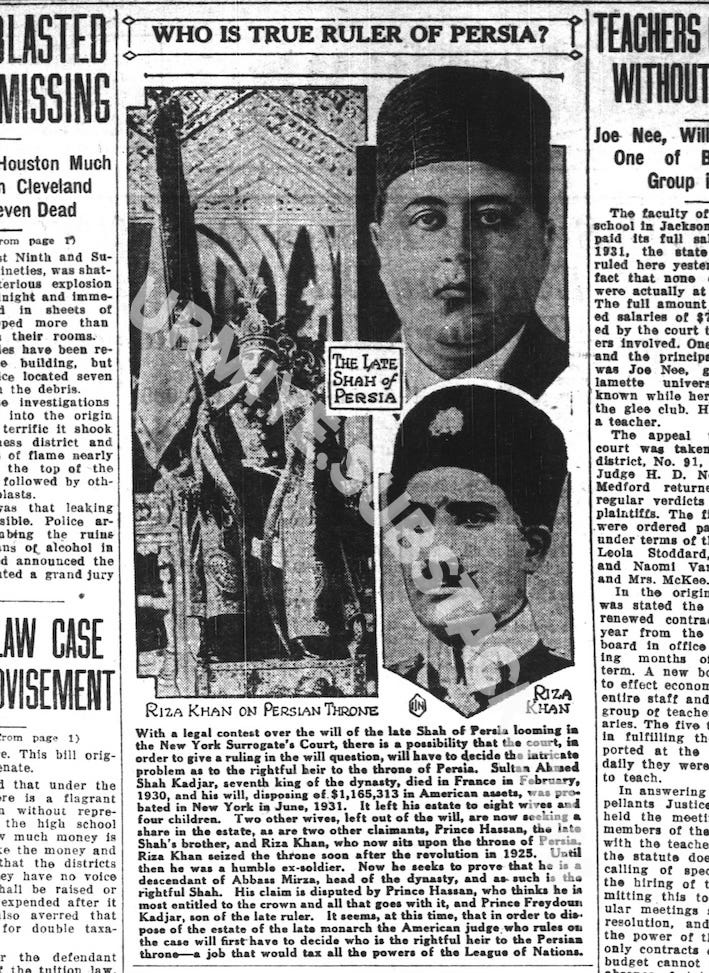
The Oregon Statesman, June 1932. Image from the author’s archive.